Many of the projects I am involved in are about developing and applying research results and technology to real life settings. That is, there is an important focus on “exploitation plans” of the research results, with the aim of commercial uptake in the market. In the OntoGrid project that is not the case. OntoGrid is a STRP (a Specific Targeted Research Project) whose focus is on research rather than on potential commercial exploitation of the project results.
Apart from mentioning that the review went very well; both the reviewers and the Commission were very happy with the project (you can read all about the project at the website www.ontogrid.net), we found an interesting distinction between research projects focused on commercial exploitation of the results, and research projects focusing on impact on the research communities. This difference is expressed in the Innovation Funnel versus the “Impact Spray” (coined by Carole Goble).
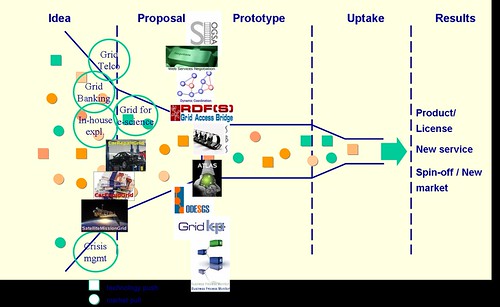
As I wrote in IEEE Intelligent System (AI’s Future: Innovating in Business and Society, May/June issue, 2006, pp 72-73), The innovation funnel models how ideas become products. Having ideas is easy, turning them into concrete proposals is a bit more difficult, transforming that into a working prototype is much harder, and commercializing the software is a completely different story. Few ideas make it to commercialization and end up in a new product, service, or even company. A consequence of the innovation funnel is that as you move from idea to results, you need increasingly more investment. Having an idea is cheap; commercializing a software product or service might involve millions of dollars. The Innovation Funnel applied to OntoGrid is illustrated in the figure below. There are quite a few ideas and proposals for technology and/or components, but only a few will make it in the end to the mainstream market (may take easily 5 years, I estimate).
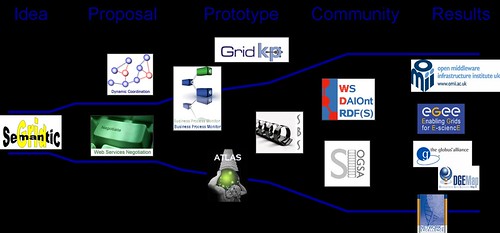
The impact spray is exactly the opposite. One starts with one main idea (Semantic Grid in this case), which leads to several proposals, which each may lead to several prototypes, etc. As the project creates more impact, and the research community takes up the individual results and starts using it, it quickly spreads out like a spray. Maybe s omething like the selfish memes of Richard Dawkins (Richard Dawkins, ``The Selfish Gene'', Oxford University Press, 1976). The figure below shows to Impact Spray applied to OntoGrid current state (© Carole Goble, as far as I know).