Thursday, March 29, 2007

Semantic Technology Annual Conference 2007 in Korea

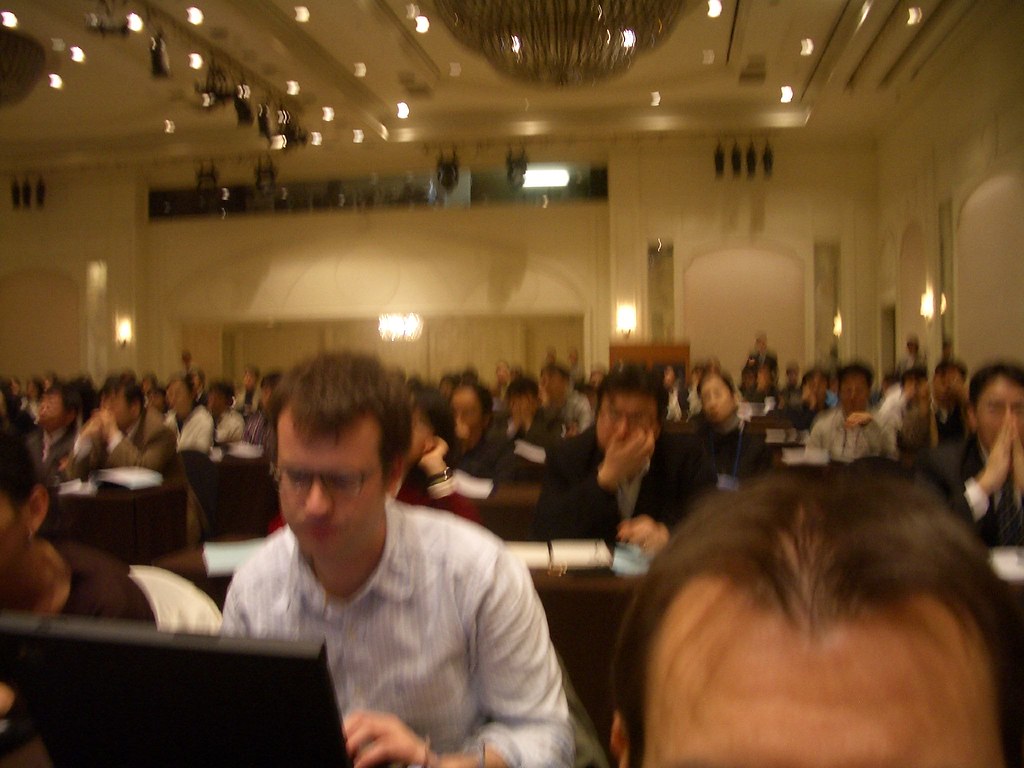
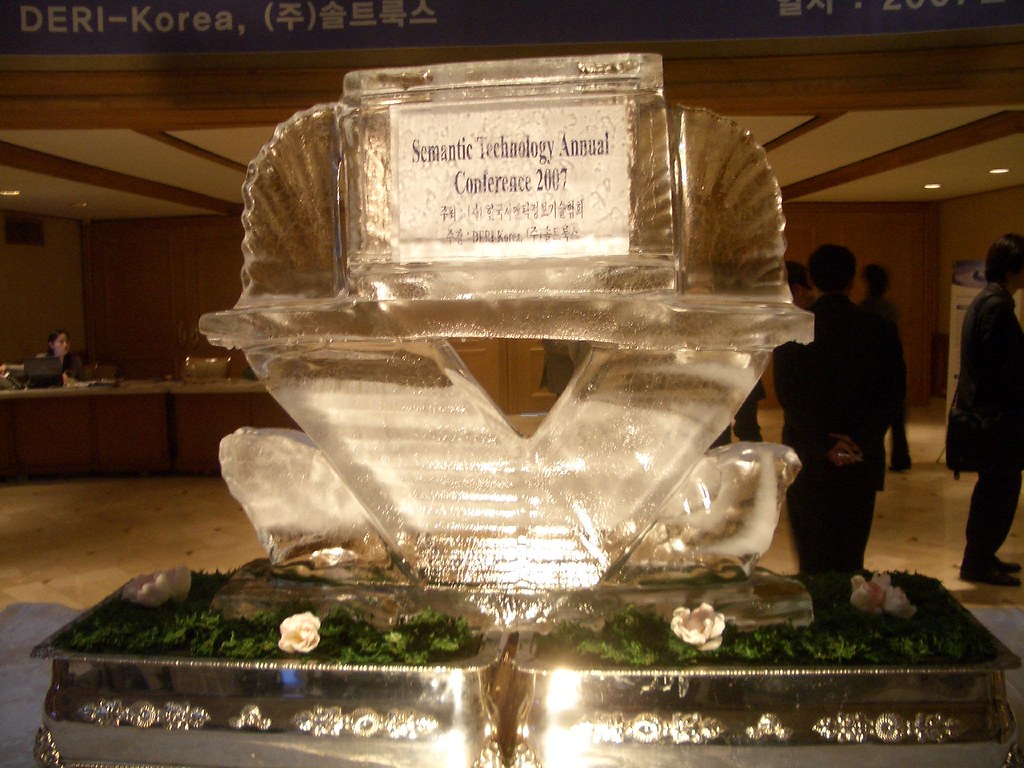
Yesterday, March 28, 2007 the South Korean Semantic Technology Annual Conference took place. Over 200 people attended, of which about 175 came from industry; a very good sign of industrial interest in corporate semantic web technology. The conferene was hosted by SemTech Korea and took place in the RitzCarlton Hotel en Seoul (see phote left). The conference was chaired by Dr. Lee, CEO of Saltlux.


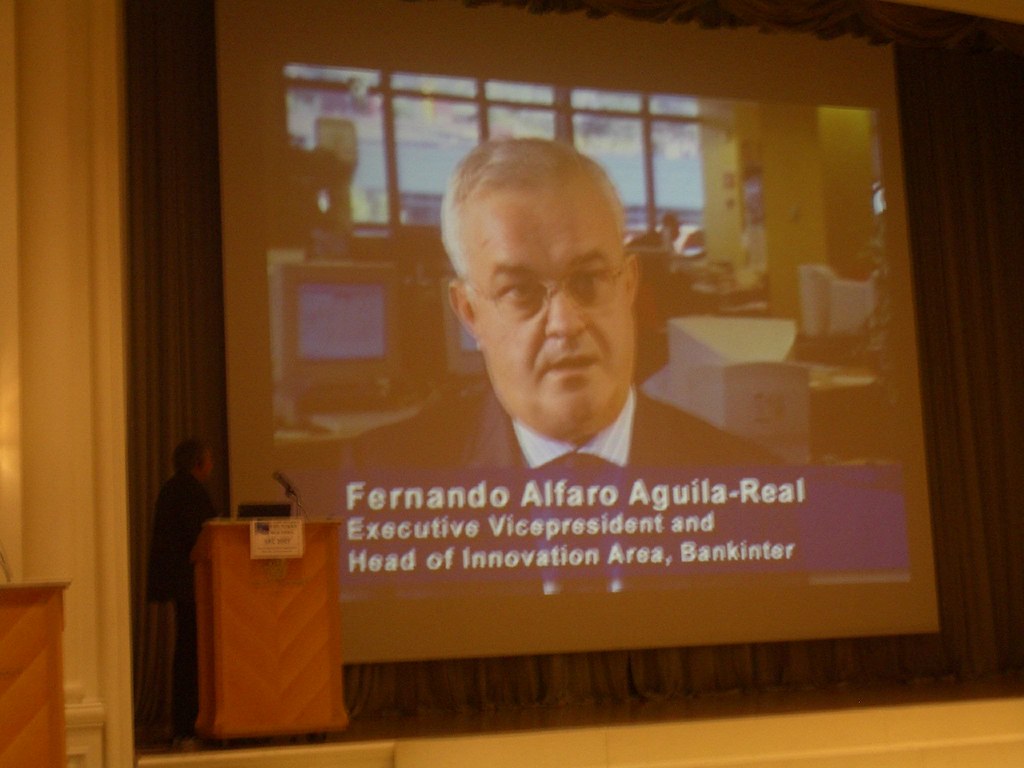
Dieter Fensel of Deri gave a talk on Service Web3.0. The future web will contain billions of services and proper management of those services (discovery, composition, execution, etc.) requires a semantic infrastucture. Prof. Fensel also showed the famous "DIP" movie that explains the business value of Semantic Web Services for industry (see photo below for the financial industry). I gave a talk on today's applications that use Semantic Technology; 7 concrete applications that we built in iSOCO for clients. Mike Ullrich from Ontoprise presented use cases of Semantic Applications. Prof. Riichiro Mizoguchi from Osaka University gave a presentation on the industrial impact of Ontology Engineering.
Below a few photos to give an impression of the conference.


This is the first time that I have been to Seoul, South Korea. In 1997 I visited Japan for the IJCAI conference. South Korea is a remarkable country. 20 years ago it was a poor county, now it is the eleventh economic power in the world. It is one of the global leaders in penetration of broadband internet and home of the world-wide known brands such as LG, Samsung, Kia, Hyundai and Daewoo. My impression of the city is a mixture between oriental and western (especially US, several Starbucks ...) culture. Doing business in Korea is also quite different from Europe, but while doing and reading one learns.

The photo below is the view on Seoul from my hotel room on the 14th floor.

Wednesday, March 07, 2007

관련 단기 강좌

On March 28, 2007 I will give an invited talk at the Semantic Technology Annual Conference 2007 in Korea. Announcement is available here.

I have many things to tell, but did't find the time to write it down.

Wednesday, February 07, 2007

The first pages of the Semantic Web? (1998), and Web2.0?

I guess everybody now and then performs an “ego search” or “ego surf”, to see what search engines give back by typing in your name and then navigating to those pages. In my case, since more than 10 years, “Richard Benjamins” gives my (old) homepage of the University of Amsterdam, where I worked between 1989 and 2000 (with temporal yearly stays at universities in Sao Paulo, Paris and Barcelona), until I joined iSOCO. Today, Google still gives the same result: http://hcs.science.uva.nl/usr/richard/home.html (sometimes a bit frustrating, where is the (Google) impact of my current work? :-).

Since I left the University of Amsterdam, I have had no access to my former homepage, so I have not been able to make any changes. At the bottom of the page you can read: “This page was last updated on 12/08/1998.” Almost 10 years ago! At the beginning, I was annoyed that I could not update the page. However, now I am actually quite happy that the page hasn’t changed since then, because it may qualify for the oldest Semantic Web page still accessible on the web (even though I think that Jim Hendler’s semantically annotated homepage appeared even earlier).

To check the “semantic webness” of the page, view the source code of the following pages:

The home page:
http://hcs.science.uva.nl/usr/richard/home.html. You will see tags in the html code “onto” that represent the semantics of terms appearing on the web page.

<a onto="page[firstName=body]">Richard</a>
<a onto="page[lastName=body]">Benjamins </a>
<A HREF="http://hcs.science.uva.nl/" onto="page[affiliation=body]"target="_top">
Dept. of Social Science Informatics (SWI)</A>
<A HREF="mailto:richard@swi.psy.uva.nl" onto="page[email=href]">

Or the publication page:
http://hcs.science.uva.nl/usr/richard/publications/pub-type.html

A semantic annotation for a book publication:

<a name="Plaza:97a" onto="name:Book"> </a>
<a name="Plaza:97a" onto="name[editor=body]"> Enric Plaza</a>,
<a name="Plaza:97a" onto="name[editor=href]"
href="http://www.iiia.csic.es/~richard/index.html">
Richard Benjamins </a> (Editors),
<a name="Plaza:97a" onto="name[title=body]"> LNAI 1319:
Knowledge Acquisition, Modeling and Management.
Proceedings of the 10th EKAW. </a>
<a name="Plaza:97a" onto="name[publisher=body]"> Springer-Verlag</a>,
<a name="Plaza:97a" onto="name[year=body]">1997</a>. <P>

Or on the projects page:
http://hcs.science.uva.nl/usr/richard/projects.html
<A HREF=http://www2.cordis.lu/tmr/src/grants/fmbi/950550.htm
onto="href:Project" onto="page[worksAtProject=href]">
Cordis entry of Using a Library with Reusable Problem-Solving
Methods to Configure Flexible and Robust Problem Solvers</A>


All those terms are (or were) specified in an ontology that was located somewhere else on a server, in this case in Karlsruhe at the AIFB institute.

This was at the time that XML began to become popular, and way before RDF and OWL came into existence. The project was called (KA)2: Knowledge Acquisition for the Knowledge Acquisition Community. How it works (or worked) can be read in:

V. R. Benjamins, D. Fensel, S. Decker and A. Gomez Perez: (KA)2: Building Ontologies for the Internet: a Mid Term Report. In the International Journal of Human-Computer Studies, 51:687-712, 1999, of which an extra official version can be found at here.

This was -to my knowledge- the first European Semantic Web project, whose idea was born at IJCAI 1997 in Nagoya, Japan during a train trip from Nagoya to Kyoto which I made with Dieter Fensel.

A lighter version of the paper can be accessed at the former so-called Banff Workshops, in 1998: V. Richard Benjamins and Dieter Fensel, Community is Knowledge! in (KA)2. I guess that should be one of the first papers on Web2.0, in 1998 :-)

Enjoy!
Tuesday, February 06, 2007

Technology Evangelist?

One of my principal activities these days is to bring Semantic Technology to markets and society in order to improve our (for the moment, professional) lives. This involves, among others, understanding of technology and market mechanisms, business insight and business development, and knowledge of processes related to innovation. Many times I find myself talking to people trying to convince them about the great things, the major leap forward, that this new technology can bring us. I am convinced myself; for sure. I often use the term: “to evangelize”, in analogy to the evangelists of the Bible.

Recently I found out that this is actually a know position in organizations, and I found a study that analyzes several important technology evangelists of Silicon Valley (I think Apple appointed the first one). The study can be found here, and I found the reference at the blog “How to Change the World” of Guy Kawasaki, quite an interesting and entertaining blog (e.g. check out the video on “The Art of the Start”).

The abstract of the study is as follows (taken from http://www.growthresourcesinc.com/TechEvan.pdf):

"The purpose of this study was to gain a clearer understanding of the relatively new phenomenon known as the "technology evangelist." By our exploration, we aim to help readers improve their management functions, and to understand how best to integrate “evangelists” within their organizations.

In order to do so, we analyzed the roles of those who hold this position and leadership styles. Our research included surveying and interviewing 29 technical evangelists worldwide from a variety of cultures and organizations.

Some general tendencies regarding the role did, indeed, emerge. However, we also discovered variable character, or personality, patterns among the participants. Therefore, we proceeded to examine the gap, between the role of the technology evangelist and the subject’s personal character.

We contrasted individual competencies with these character patterns, and created a grid to analyze their qualities of leadership. This paper includes our recommendations for recruiting, integrating, developing and managing the technology evangelists."

Enjoy!

Saturday, January 20, 2007

1st European Semantic Technology Conference (ESTC2007) initiates a new conference series in Semantic technologies in Europe

1st European Semantic Technology Conference (ESTC2007) initiates a new conference series in Semantic technologies in Europe

The European Semantic Technologies Conference aims to be the European platform for bringing together those who use Semantic Technologies in their business, those who implement Semantic Solutions and those who build semantically-enabled products. So far, existing events around Semantic Technologies have been mostly academically oriented. With the technology becoming more mature and deployed, the need for a more industrial and commercially oriented event is evident.

The following texts come from a press release and the Call for Presentations of ESTC 2007. Full press release can be found here.

ESTC2007 is a new European meeting place for users, practitioners, developers and researchers to discuss the applicability and commercialization of semantic technologies for enterprises and public organizations. ESTC also enables delegates to understand Semantic Technologies and their potential and how to exploit these technologies in their organizations.

The conference will be held in Hofburg Redouten Säle, Vienna, Austria, May 31 – June 1, 2007 and will feature case study and practical experience presentations, workshops and tutorials, invited talks and an industrial exhibition.

Conference chairman Dr John Davies, Head of BT’s Next Generation Web unit, said “I am very pleased to be able to announce the initiation of this conference series. Given the increasing maturity of semantic technology, the time is right to complement more technical and academic conferences in this area with an annual European conference focusing on deployment and the commercial benefits semantic technology can deliver.”

The first ESTC is looking for contributions of:
  • Businesses and public organizations describing their practical experience (case studies) in using Semantic Technologies (the problem, the solution, initial expectations, the project, results, cost/benefit)
  • Vendor reports on semantically-enabled products and solutions
  • Analyst reports on the current market situation for Semantic Technologies

In particular, we invite the submission of case studies, reports and practical experience papers.

The full CFP can be found here.

The Program Chair is advised by a Program Advisory Board, which consists of a mixture of industrial people, research analysts, venture capitalists, and renowned academics with an interest in applied research.

Tuesday, January 16, 2007

But how does a VC think about the Semantic Web?

A few days ago, someone sent me a pointer to a presentation given by one of the investors in Radar Networks, Peter Rip of Crosslink Capital, entitled: "Semantic Web, What Does It All Mean for You?" (Radar Networks was mentioned in the article "Entrepreneurs See a Web Guided by Common Sense, John Markoff, New York Times: November 12, 2006 ", see my post of Jan 1, 2007).

I was surprised by the simplicity and clearness of this presentation concerning its relation to Web2.0. Basically, he views Web2.0 as a "poor man´s Semantic Web". Bringing the Web to its full potential requires the Semantic Web. Check it yourself here. The presentation is posted on this blog.

Wednesday, January 10, 2007

The Value of Semantic Web Services for Business and Society

In an earlier post, I wrote about the DIP project and mentioned there: "There is also a movie available explaining the value of the project in terms of three particular sectors, e-government, telco, and e-banking." The movie has now been finished and released and can be watched in this blog, as well as on the DIP home page.

Again, DIP has been a very ambitious, yet successful project which potential for major impact in society and businesses. In a few months, I hope to be able to be a bit more precise about some of those business opportunities.


If the movie doesn´t show, please click here to view it on the KMI website.

Some quotes from the Final Review Report:

"... the work that has been carried out by the DIP consortium and the way in which the consortium has carried out that work. The DIP partners have ensured that the project has become a flagship project."

"Overall, DIP has been a paragon of collaborative research. "

"The reviewers would be pleased if DIP was drawn on by the CEC as an exemplar project, in order to demonstrate the increased value of carrying out international collaborative research."

"Technically the project has produced excellent results "

Enjoy!

Monday, January 01, 2007

Semantic Web, Web2.0, Web3.0 …

The past few months I have been puzzled with the message of some publications regarding the Semantic Web (or better “Semantic Technologies”), Web2.0, Web3.0, and in particular with interpreting what this means for uptake of Semantic Technologies in the market.

The publications in question are:


At first sight, it seems that Web2.0 is receiving the media attention that previously was given to the Semantic Web. In the figure below, which is generated with Google Trends, the blue line represents the Semantic Web and the red line Web2.0. The top part refers to web pages mentioning the terms; the bottom part refers to news appearance.


In the 2006 edition of Gartner’s Hype Curve, the Public Semantic Web is at the through of disillusionment and is estimated to take between 5 and 10 years to reach the plateau of productivity. Web2.0 and the Corporate Semantic Web, on the other hand, are at the Peak of Inflated Expectations, the former reaching its plateau in an estimated 2-5 years, and the latter 5-10 years.

GoogleTrends-SW_Web20

One reason for these phenomena is that Semantic Technologies build up an infrastructure on top of which the web can grow to its full potential, whereas Web2.0 is related to communities of final users (e.g. http://www.youtube.com/, http://www.wikipedia.org/). One consequence of this is that Web2.0 is much more visible than Semantic Technologies, and thus it is much easier to attract attention of a large audience. Semantic Technologies is supposed to create an (invisible) infrastructure, whereas Web2.0 creates highly visible applications for final users using the existing web, but with a significantly improved user interface (thanks to AJAX). This would also explain why there is disappointment with the Public Semantic Web (the large public hasn’t seen anything yet); whereas the Corporate Semantic Web is still peaking. Businesses see a huge benefit of, for example, better access to important corporate information in unstructured documents (Mike Lynch, CEO and Founder of Autonomy, estimates that 80% of corporate information is hidden in unstructured documents). Businesses are not interested in final user applications, but in promising technology that can help them to better manage their information.
For me, one of the most striking achievements of Web2.0 is its capacity to involve large active user communities. Indeed, this has been a (happy) surprise. At the beginning of the Semantic Web effort, many of us were convinced that it would never be possible to annotate web content with (semantic) tags through human effort. Therefore, much research effort was dedicated to automatically generating annotations using advanced Natural Language Processing techniques. Web2.0 initiatives have shown this assumption to be false; it is possible to tag large amounts of multimedia and text documents by communities of people.

Recently the term Web3.0 is getting popular, which refers –freely interpreted- to the combination of Web2.0 and the Semantic Web.

My take on this is that we will hear much from Semantic Technologies in the context of corporations. The Public Semantic Web will regain strength in combination with Web2.0 aspects, strengthening the notion of Web3.0.

Happy 2007!

Friday, November 24, 2006

So much compelling technology and all freely available under LGPL .

On November 16-17, 2006 the final review of the SEKT project took place in BT´s installations in Ipswich, UK. SEKT is three years European IST project (running from Jan 2004 to Dec 2006) aimed at improving Knowledge Management using Semantic Technologies. The project was organised in several technology work packages (with the aim to create innovative and cutting edge technology), and three application (case study) work packages (to provide real life requirements and to provide a testbed). The three applications are related to

  • A large Digital Library
  • Decision support for (Spanish) Judges on duty
  • Knowledge management for an IT consultancy company

The technology developed can be divided in different groups

  • Text mining, ontology learning, clustering components to structure "hidden" information
  • Natural language processing components to extract semantic information from unstructured content
  • Ontology engineering software (editing, mapping and versioning)
  • Components for automatic annotation
  • An integration platform compliant with industry standards

Specific effort has been dedicated to scalability and methodological aspects of semantic solutions.

The SEKT project has produced an impressive list of software components that -if configured rightly- can solve many existing knowledge management problems. The good thing is that most software is freely available under the LGPL license.

So, any company (and of course university) with technological IT skills, can simply go to www.sekt-project.com and download the components of interest, and plug and play prototypes.

In addition, the project has produced a training website, with movie material to get quickly up to speed with Semantic Technologies. This includes movies taken from SEKT people giving tutorials and screen cams from the software and applications. There is also a website especially aimed at decision makers and IT managers.

The review went very well. The EC, the reviewers and the project partners were very satisfied. To be continued ...?

Wednesday, November 22, 2006

FP7, a happy surprise

As you’ve read before in this blog, I am attending the IST Conference in Helsinki. During the session on Intelligent Content and Semantics, Stefano Bertolo gave a practical presentation on FP7 proposals. The happy surprise concerns the so-called STR-D projects (Specifically Targeted Research Projects – Demonstration) geared towards field experimentation (“use cases”).

ISTConf2006-Helsinki-SemanticContent

Projects of this kind are (quoting from Bertolo, full presentation here):

  • centred around existing, promising but untried technologies
  • designed to go one step forward towards
    • packaging, configuring … and testing
  • assess suitability & viability
    • functionality
    • performance
    • usability (hide technical complexity!
  • within a well defined domain / user context
  • rigorous evaluation plans & metrics
  • active user involvement & feedback
  • adequate documentation of results (positive/negative)

Throughout my postings in this blog so-far you may have read some frustration about the difficulty in closing the gap between R&D results and the market. To me it seems that these STR-D projects could play a promising role in filling this gap. It allows, for example, to take results of existing R&D projects (e.g. the SEKT project), and develop them a step further into direction of the market. This form of project seems to acknowledge that it is hard and expensive (and involving high technology risk) to bring R&D results to the market, and therefore I applaud it.

Sunday, November 19, 2006

Innovation Funnels and Impact Sprays

On Nov. 14, 2006 the second annual review of the OntoGrid project took place in Brussels. The goal of the OntoGrid project is to design an architecture for the Semantic Grid; the long hoped for combination of Grid and Semantic Web. The idea is to add semantic metadata to Grid resources (so-called “semantic bindings”) such that Grid resources can be reasoned about, thereby paving the way for automatic discovery, selection and combination of Grid resources. In this sense the Semantic Grid and Semantic Web Services have several things in common (see my posting on the DIP project)

Many of the projects I am involved in are about developing and applying research results and technology to real life settings. That is, there is an important focus on “exploitation plans” of the research results, with the aim of commercial uptake in the market. In the OntoGrid project that is not the case. OntoGrid is a STRP (a Specific Targeted Research Project) whose focus is on research rather than on potential commercial exploitation of the project results.

Apart from mentioning that the review went very well; both the reviewers and the Commission were very happy with the project (you can read all about the project at the website www.ontogrid.net), we found an interesting distinction between research projects focused on commercial exploitation of the results, and research projects focusing on impact on the research communities. This difference is expressed in the Innovation Funnel versus the “Impact Spray” (coined by Carole Goble).

As I wrote in IEEE Intelligent System (AI’s Future: Innovating in Business and Society, May/June issue, 2006, pp 72-73), The innovation funnel models how ideas become products. Having ideas is easy, turning them into concrete proposals is a bit more difficult, transforming that into a working prototype is much harder, and commercializing the software is a completely different story. Few ideas make it to commercialization and end up in a new product, service, or even company. A consequence of the innovation funnel is that as you move from idea to results, you need increasingly more investment. Having an idea is cheap; commercializing a software product or service might involve millions of dollars. The Innovation Funnel applied to OntoGrid is illustrated in the figure below. There are quite a few ideas and proposals for technology and/or components, but only a few will make it in the end to the mainstream market (may take easily 5 years, I estimate).

InnovationFunnel-Ontogrid


The impact spray is exactly the opposite. One starts with one main idea (Semantic Grid in this case), which leads to several proposals, which each may lead to several prototypes, etc. As the project creates more impact, and the research community takes up the individual results and starts using it, it quickly spreads out like a spray. Maybe s omething like the selfish memes of Richard Dawkins (Richard Dawkins, ``The Selfish Gene'', Oxford University Press, 1976). The figure below shows to Impact Spray applied to OntoGrid current state (© Carole Goble, as far as I know).

impact-spray

Wednesday, November 15, 2006

The 2006 edition of the IST Conference, Nov. 22, Helsinki

Next week, I will give two presentations at the IST conference about applications using Semantic Technology in enterprises and public organisations. One presentation is a general one discussing the market (estimated size, drivers, and inhabitants) for Semantic Technology, several applications (both for corporate and public Semantic Web), and some barriers this type of technology is likely to encounter. The presentation can be downloaded here.

Date, time and place: Intelligent Content and Semantics, 22 November 2006, 14:00-15:30, The Helsinki Fair Centre, room Lappeenranta

The other presentation discusses a semantic application for Spanish judges, and in particular recent judges. In order to become a judge in Spain, one has to pass a public exam held as a competition. Only the top performers are invited to become judge. Once accepted, the recent judge gets all responsibilities, but has still little practical knowledge. The system we are building provides a solution for this problem in the form of an intelligent FAQ system. We built a high-quality corpus of about 1000 frequently asked question-answer pairs, collected and maintained, based on interviews with more than 400 judges. The judges can query the system in natural language (e.g. "I have given an injunction of protection and the woman is asking me for a withdrawal of the measure. Should I withdraw it?"), and get as result a list of related question answer pairs. In addition, it provides a list of documents with related sentences to the answer.

The novelty of the system is they way in which relevant question-answer pairs are retrieved, namely based on domain semantics, represented in ontologies. We can say that –to some extent- the system “understands” the user query, and based on this understanding, provides relevant results. The presentation can be here.
The session is called: Building Semantic Knowledge Applications and the program is:

11.00 – 11.05 Introduction and overview
Dr. John Davies
11.05 – 11.15 A Semantic Application for Spanish Judges
Dr. V. Richard Benjamins
11.15 – 11.25 Large-scale semantic web applications
Professor Enrico Motta
11.25 – 11.35 A case study in semantic web services
DIP project representative
11.35 – 11.55 Providing Intelligent Content by Using Web Semantics and Web Mining
Dr. Pinar Senkul, Dr. Marko Grobelnik, Professor Josiane Mothe
11.45 – 11.55 The Role of Language - Extending the Semantic Web towards Web Pragmatics
Professor Kurt Englmeier
11.55 – 12.10 Cost estimation for ontology engineering
Prof. Rudi Studer
12.10 – 12.30 Panel discussion
Facilitated by Dr John Davies


Enjoy!

Wednesday, November 08, 2006

Semantic Web and Web2.0

Since some time, I am asking myself the question “what does Web2.0 mean for a company like iSOCO”, which is currently focusing on bringing Semantic Web technology to the market. Both technologies are expected to have high impact on businesses and society. But what is their relation? Are they complementary or competitors for achieving the same dream? When one says “Semantic Web”, one says “ontologies”; formal web representations of knowledge of a particular domain. When saying “Web2.0”, one says “communities”, “services” and much more (see http://www.oreillynet.com/pub/a/oreilly/tim/news/2005/09/30/what-is-web-20.html).

In my view, they are complementary, both helping to bring the web to its full potential for society and businesses. Rather than expressing this in text, I tried to add relevant tags (for Semantic Web and Web2.0) to all our Semantic Web applications we have been built over the past few years. The presentation can be downloaded here. Enjoy! It also includes a small introduction to iSOCO, but you can safely skip that.

Friday, October 27, 2006

Final review DIP project


This week we celebrated the final review of the DIP project (http://dip.semanticweb.org/), which stands for Data, Information, and Process Integration with Semantic Web Services. DIP is a 16 MEuro, 3 year project partially funded by the European Commission, involving about 20 top class industrial and academic partners, including SAP, BT, iSOCO, Unicorn (IBM), Hanival, OU, EPFL, FZI, etc.). DIP finishes on December 31, 2006.

During the final review of two days, 40 members of the consortium presented the results to three external experts hired by the EC, and to the EC Project Officer. Wonderful new technology has been developed that has the potential to change businesses in the future. In the context of this blog, I am especially interested in what happens with all this technology once the project has finished. Of the two day review, almost half a day was dedicated to exploitation plans, which in itself is a positive exception. Exploitation plans lay out the realistic intentions of the consortium to use (apply, commercialize) project results beyond the scope of the project.

The highlights of the exploitation session included:

  • Many different kind of commercial exploitation plans
  • Firm commitment to create a new company
  • Acquisition of DIP partner by large IT company
  • Vertical exploitation of case studies in particular sectors
  • Horizontal exploitation through acquisition of DIP partner
  • Joint exploitation plans for large organizations and SMEs
  • All licensing for core technology is Open Source
  • Academic exploitation through take up in many recent R&D projects
  • Strong influence on standards in two leading standards bodies

In three or five years we will see how many of the exploitation plans have become reality.

Needless to say, that the review was a big success (flagship project, an example).

There is also a movie available explaining the value of the project in terms of three particular sectors, e-government, telco, and e-banking. I will make the movie later available on this blog.

Wednesday, October 04, 2006

TinyURL

Innovation is sometimes defined as “the introduction of something new and useful”. A very simple example of such innovation is http://tinyurl.com. It changes long URLs into short ones. How often have you received en email with a URL (often to a dynamically generated webpage from a database) of several lines that your mail client has broken into parts that you need to copy and paste manually into your browser? Too often? Tinyurl solves this problem completely by turning your long URL (before sending it by email) into a short one. It works, it is simple, and free. That is innovation!

Tuesday, October 03, 2006

Budget for Writing Exploitation Plans in R&D Projects

Needless to say that the IST program of the European Commission is enormously stimulating the R&D activities in European universities and companies. But what about real innovation based on this research?

As mentioned previously, and as I will explain in later writings, the commercial exploitation of R&D results is not easy. It starts with designing good and realistic exploitation plans. A fully fledged exploitation plan is something like a business plan that you can present to top management or VCs with the objective to raise money for starting a new business.

Even though the European Commission (EC) is keen on commercialising technology and tools originated in European IST research projects, their main objective is to investigate and develop new technology, not to innovate in businesses and society. EU research projects thus focus on exploitation plans, while other programs such as eTen or eContent Plus focus more on respectively commercialisation and applications. However, the largest share of public funding goes to IST research projects.

This creates a situation where

  • The EC is very keen on commercial exploitation plans of consortia
  • The research projects are not the optimal instrument to generate realistic, well founded exploitation plans (for several reasons, as I will explain in later writings).

Below you can see an illustrative table with some of the projects I have participated (participate) in along with the relation between effort dedicated to R&D, and effort reserved for dissemination and exploitation plans. Notice that most of the projects are in the Semantic Web area.


On average, only 8 percent of the effort is devoted to dissemination exploitation, so even less is dedicated to writing exploitation plans. We have to take into account that those efforts are assigned by the consortia themselves, not by the EC. Although the percentage is low (with the exception of the last two projects, Super and Neon), the actual efforts in person months are not so low. E.g. 36 person months is equivalent to three persons working full time during one year on a particular topic. Yet, it seems very hard for consortia to come up with realistic exploitation plans that –after project termination- give rise to commercial exploitation. Several reasons come to my mind.

  • The interest of people participating in research projects is research, not marketing.
  • Exploitation is considered as a requirement imposed by the EC at the time of proposal submission and contract negotiation, and therefore is added artificially.
  • Researchers are good at research, not necessarily at writing business plans.
  • Research projects are long term (3-4 years), whereas commercial opportunities are planned on a shorter time scale.

I can continue enumerating many more reasons. I will elaborate on some of them later on, and also provide some ideas on how to improve the commercial exploitation of research results. However, this is mainly a high-level political issue to “make the EU the most competitive and dynamic knowledge-based economy in the world.”

Keep innovating!

Monday, October 02, 2006

Innovation and European R&D (IST) projects

In the past years (FP4, 5, 6), I have extensively participated in European IST Research projects. More and more I have seen a shift of the European Commission from basic research to commercial exploitation. The “Exploitation Plans” of the consortium are one of the most important topics during the final reviews. An exploitation plan lays out the plans of the consortium (members) of how to commercially exploit the R&D results obtained during the project. Take into account that, for private organizations, EU projects are co-financed between the EU and the private organization. Some return on investment would not be so strange …

How often do R&D results of European Projects hit the market successfully? Actually, I do not have figures or statistics on this, but would be very interested (anybody has an idea? Please let me know). It is my impression –both as researcher and as EC reviewer and evaluator- that there are very few R&D results that make it successfully to the market. And this is a pity. In the following writings I will analyse why –in my experience- this is the case, talking about factors such as:
• The relative budget allocation to “exploitation” of R&D results,
• The composition of consortia (people organizations),
• The ambition of proposals (the sky is the limit) versus the reality at project end,
• The speed at which things happen in large R&D projects versus the rapid changes in the market and technology landscape,
• The innovation funnel,
• The technology adoption lifecycle,
• Gartner’s Hype curves,
• European university education on creating companies,
• European entrepreneurial culture and mentality,
• Etc.

The EC goal (Lisbon Council) is/was to make Europe the most competitive knowledge-based economy in the world by 2010. That only can/could happen if innovation happens at a very rapid pace, bringing new technology to the market in record times. That is still an important goal for Europe, and something I feel as a personal mission related to Semantic Web technology. But it is very hard; success is more an exception than a rule.

Stay tuned.

Monday, September 04, 2006

First posting: introduction


I am director of Innovation and Research & Development, and Board Member at Intelligent Software Components, S.A. (iSOCO) It is our mission to help organizations innovate in their businesses using advanced ICT. In the network economy, it is increasingly important to delegate knowledge-intensive tasks to software.