Business Week has published an interesting article on the battle between Europe and US concerning Semantic Web (or Web3.0) technology. A nice illustration of how innovations usually happen, with some hope for a change in favor of Europe.
Enjoy!
Showing posts with label Semantic Web. Show all posts
Showing posts with label Semantic Web. Show all posts
Friday, July 27, 2007


Wednesday, June 06, 2007
W3C SWEO Publishes Case Studies
The Semantic Web Education and Outreach Interest Group (SWEO) of the World-Wide Web Consortium, headed by Tim Berners-Lee, publishes a list of concrete applications based on Semantic Technologies, presented by clients, rather than by technology vendors/providers. The list will be augmented as new applications are submitted. As of June 6, 2007, the list contains 18 applications, of which five are using semantic technology of iSOCO.
The announcement has been made by Susie Stephen of Eli Lilly and is reproduced here:
"The Semantic Web Education and Outreach (SWEO) Interest Group is pleased to announce the first set of Case Studies and Use Cases giving some examples of how the Semantic Web of machine readable data is used today. Applications are presented in areas ranging from automotive to health care, and from B2B systems to geographical information systems. The SWEO Interest Group will continue to publish new Case Studies and Use Cases in the future; an RSS feed for new submissions is available. A short overview is also available in Open Document Format, PDF, and HTML formats. "
The announcement has been made by Susie Stephen of Eli Lilly and is reproduced here:
"The Semantic Web Education and Outreach (SWEO) Interest Group is pleased to announce the first set of Case Studies and Use Cases giving some examples of how the Semantic Web of machine readable data is used today. Applications are presented in areas ranging from automotive to health care, and from B2B systems to geographical information systems. The SWEO Interest Group will continue to publish new Case Studies and Use Cases in the future; an RSS feed for new submissions is available. A short overview is also available in Open Document Format, PDF, and HTML formats. "
Tuesday, May 22, 2007
New Gartner Report on Semantic Technologies
In a recent report of May 9, 2007, Gartner gives its view and recommendations to organizations concerning “Finding and Exploiting Value in Semantic Technologies on the Web”. You can buy it here. My interpretation of this report is:
Value Proposition
Semantic Technologies will are gradually being taken up by organizations.
It will offer extraordinary advances for exploitation and visibility of information, in particular regarding the automatic interpretation of documents (unstructured information), i.e. without human intervention.
This will unleash information in organizations that currently is hidden in documents such as html, doc, ppt. pdf, xls, etc.
Industry Uptake and Recommendation to Organizations
Industry uptake will be gradual starting with focused applications using semantic hypertext (microformats, a Web2.0 technology) that embeds semantic tags in web pages
By carefully selecting focused projects to start with, Industry can already gain significantly today
Prediction
In the next 10 years, web-based technologies will be increasingly able to embed semantics in documents.
By 2012, 70% of public web pages are expected to include some level of semantic mark-up
The full blown public semantic web, using OWL, will take several more years to come to maturity.
In short, the web will gradually incorporate semantics starting with lightweight semantic hypertext (microformats) to more heavyweight ontologies. This vision is consistent with my own experience with clients: start small and simple, but with the big picture in mind. Semantic technologies owe to Web2.0 technologies -where semantic tags are attached to content out of pure necessity- in the sense that it is now widely recognized that (some kind of) semantics is needed to keep the web a friendly place to be. Some people (e.g. Mor Naaman of Yahoo!Research) express the same trend in a (very) different way, but the essence of the message is the same.
Value Proposition
Industry Uptake and Recommendation to Organizations
Prediction
In short, the web will gradually incorporate semantics starting with lightweight semantic hypertext (microformats) to more heavyweight ontologies. This vision is consistent with my own experience with clients: start small and simple, but with the big picture in mind. Semantic technologies owe to Web2.0 technologies -where semantic tags are attached to content out of pure necessity- in the sense that it is now widely recognized that (some kind of) semantics is needed to keep the web a friendly place to be. Some people (e.g. Mor Naaman of Yahoo!Research) express the same trend in a (very) different way, but the essence of the message is the same.
Monday, April 23, 2007
Norwegian Semantic Days 2007
On April 23, 24 the Norwegian Semantic Days, 2007 will take (took) place in Stavanger. I will give a keynote on Semantic Solutions for the Enterprise, which can be downloaded here.
Speakers of other keynotes include Ivan Herman of W3C, Ian Horrocks of University of Manchester and Susie Stephens of Eli Lilly and responsible for W3C's Semantic Web Education and Outreach (SWEO) Interest Group.
All presentations given at the conference can be downloaded here.
Speakers of other keynotes include Ivan Herman of W3C, Ian Horrocks of University of Manchester and Susie Stephens of Eli Lilly and responsible for W3C's Semantic Web Education and Outreach (SWEO) Interest Group.
All presentations given at the conference can be downloaded here.
Friday, April 20, 2007
BusinessWeek about the Semantic Web
In a special report on April 9, 2007, Businessweek published several interesting things about the Semantic Web on its website. There is an article called "Taming the World Wide Web", starting with the explaining the value of this technology for the pharmaceutical sector. There is also a podcast, called "The CEO Guide to the Semantic Web".
Enjoy (I use this blog also as a kind of storage for relevant pointers).
Enjoy (I use this blog also as a kind of storage for relevant pointers).
Tuesday, April 10, 2007
A New Generation Search Engines
The Financial Times recently published a short note: “New tools to vie with Google”, which briefly describes –from a user point of view- some of the new generation search engines. It includes new search engines like:
All those search engines allow queries in natural language, and they claim to use NLP and semantics to “understand” the content.
In my understanding, there are two ways where NLP and Semantics can play a role:
The short note of Paul Taylor also mentions several “search” engines for comparing prices of products available on the web, including
- http://www.ask.com/
- http://www.powerset.com/
- http://www.askmenow.com/
- http://www.hakia.com/
- http://www.digger.com/
- http://www.blinkx.com/ (video clips)
- http://www.retrivo.com/ (electronics products)
- http://www.kosmix.com/ (health, travel, finance, US politics)
All those search engines allow queries in natural language, and they claim to use NLP and semantics to “understand” the content.
In my understanding, there are two ways where NLP and Semantics can play a role:
- Interpreting the user query. This is what most new search engines claim to do.
- “Understanding” the content to be indexed. This requires that at index time, not only the individual words of the content (documents) are indexed, but indexing also considers NLP and Semantics. It is unclear to what extent those “new” search engines apply this for indexing. Yet another possibility is to launch the query against structured information (e.g. RDF).
The short note of Paul Taylor also mentions several “search” engines for comparing prices of products available on the web, including
- Shopzilla
- Pricegrabber
- Shopping.com
While the note talks about those “shopping bots” for consumers, also providers (the businesses) may have interest in such tools for tracking their products at resellers’ sites and for automatically tracking their competitors’ products.
Thursday, April 05, 2007
The Web of Data
In this movie, Tim Berners-Lee explains the Web of Data, one of the goals of the Semantic Web. It provides several concrete examples of what the Semantic Web would be useful for from an end user point of view. Enjoy!
Thursday, March 29, 2007
Semantic Technology Annual Conference 2007 in Korea
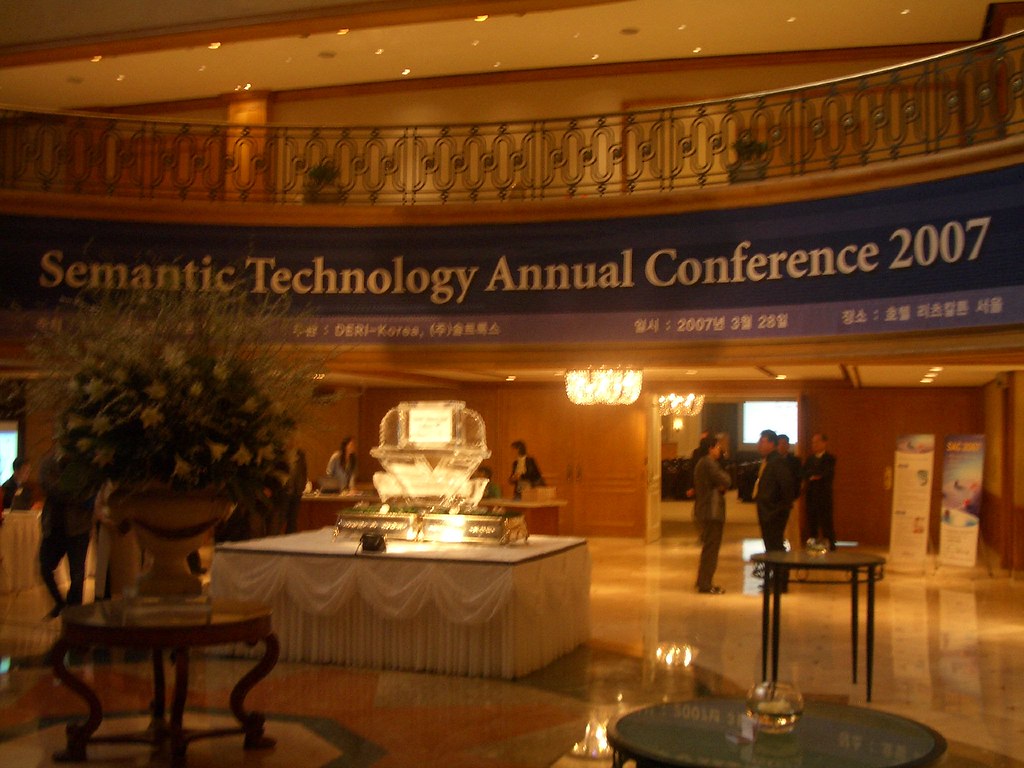 Yesterday, March 28, 2007 the South Korean Semantic Technology Annual Conference took place. Over 200 people attended, of which about 175 came from industry; a very good sign of industrial interest in corporate semantic web technology. The conferene was hosted by SemTech Korea and took place in the RitzCarlton Hotel en Seoul (see phote left). The conference was chaired by Dr. Lee, CEO of Saltlux.
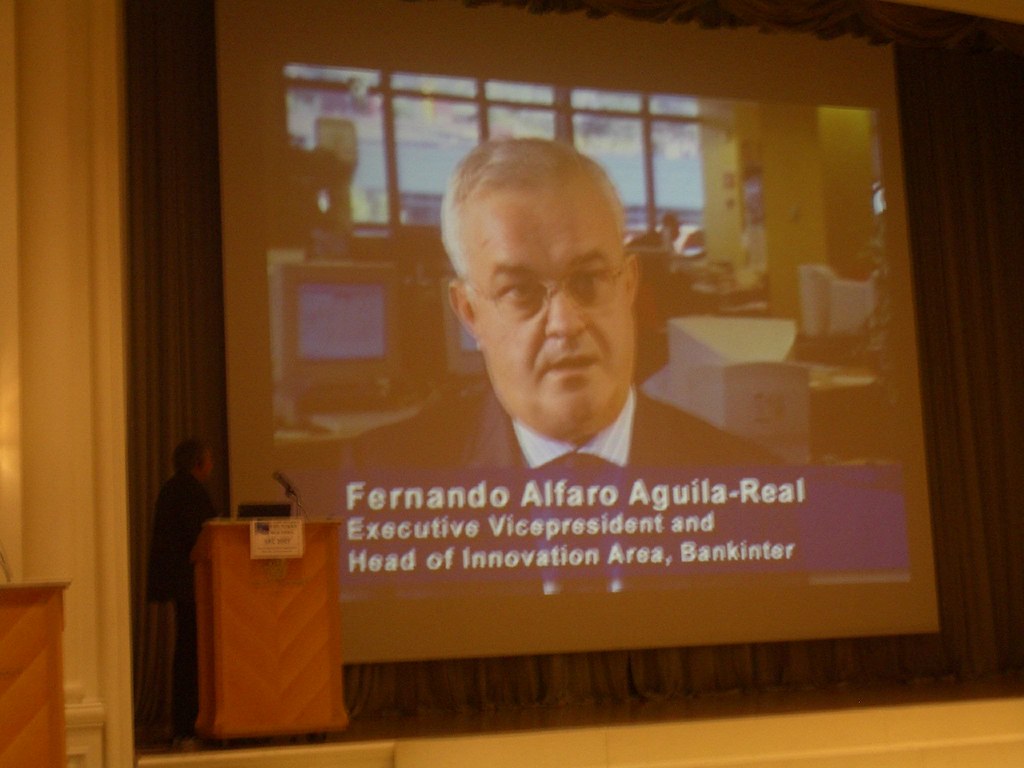
Dieter Fensel of Deri gave a talk on Service Web3.0. The future web will contain billions of services and proper management of those services (discovery, composition, execution, etc.) requires a semantic infrastucture. Prof. Fensel also showed the famous "DIP" movie that explains the business value of Semantic Web Services for industry (see photo below for the financial industry). I gave a talk on today's applications that use Semantic Technology; 7 concrete applications that we built in iSOCO for clients. Mike Ullrich from Ontoprise presented use cases of Semantic Applications. Prof. Riichiro Mizoguchi from Osaka University gave a presentation on the industrial impact of Ontology Engineering.
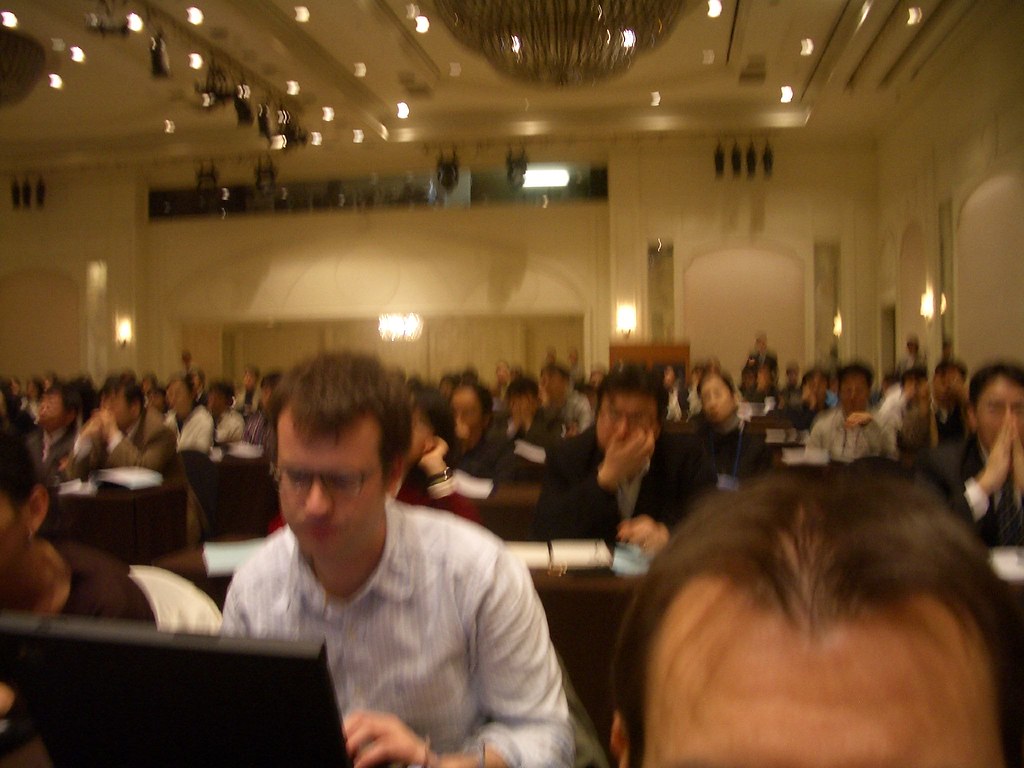
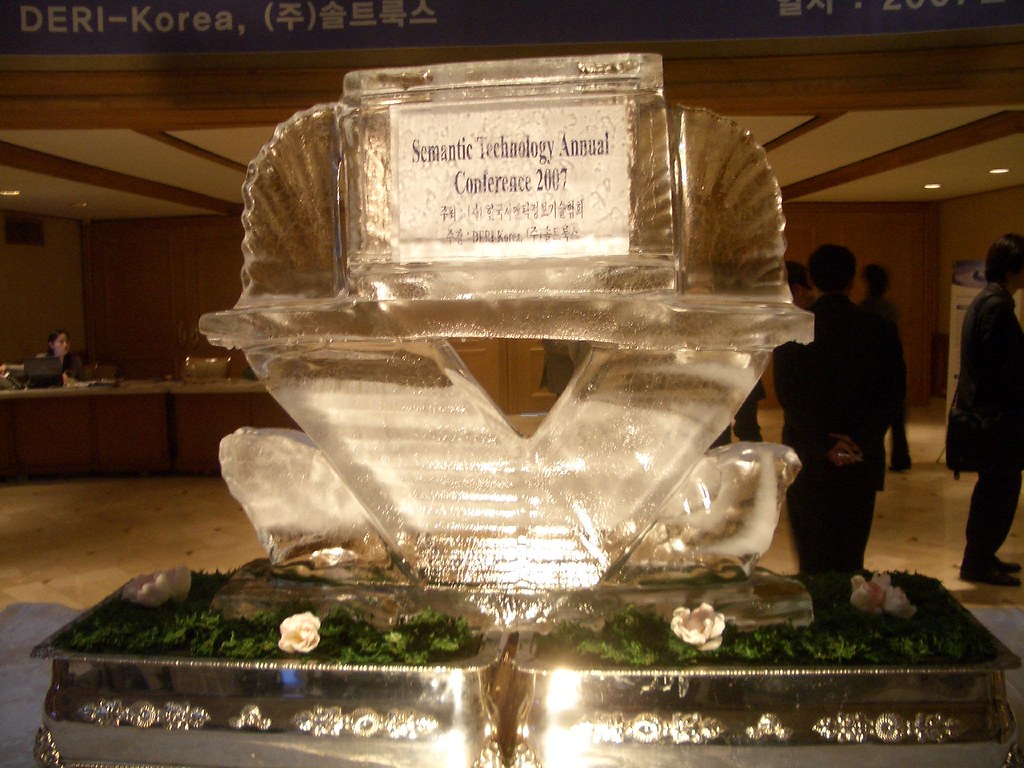
Below a few photos to give an impression of the conference.

This is the first time that I have been to Seoul, South Korea. In 1997 I visited Japan for the IJCAI conference. South Korea is a remarkable country. 20 years ago it was a poor county, now it is the eleventh economic power in the world. It is one of the global leaders in penetration of broadband internet and home of the world-wide known brands such as LG, Samsung, Kia, Hyundai and Daewoo. My impression of the city is a mixture between oriental and western (especially US, several Starbucks ...) culture. Doing business in Korea is also quite different from Europe, but while doing and reading one learns.
The photo below is the view on Seoul from my hotel room on the 14th floor.


Wednesday, March 07, 2007
Wednesday, February 07, 2007
The first pages of the Semantic Web? (1998), and Web2.0?
I guess everybody now and then performs an “ego search” or “ego surf”, to see what search engines give back by typing in your name and then navigating to those pages. In my case, since more than 10 years, “Richard Benjamins” gives my (old) homepage of the University of Amsterdam, where I worked between 1989 and 2000 (with temporal yearly stays at universities in Sao Paulo, Paris and Barcelona), until I joined iSOCO. Today, Google still gives the same result: http://hcs.science.uva.nl/usr/richard/home.html (sometimes a bit frustrating, where is the (Google) impact of my current work? :-).
Since I left the University of Amsterdam, I have had no access to my former homepage, so I have not been able to make any changes. At the bottom of the page you can read: “This page was last updated on 12/08/1998.” Almost 10 years ago! At the beginning, I was annoyed that I could not update the page. However, now I am actually quite happy that the page hasn’t changed since then, because it may qualify for the oldest Semantic Web page still accessible on the web (even though I think that Jim Hendler’s semantically annotated homepage appeared even earlier).
To check the “semantic webness” of the page, view the source code of the following pages:
The home page:
http://hcs.science.uva.nl/usr/richard/home.html. You will see tags in the html code “onto” that represent the semantics of terms appearing on the web page.
<a onto="page[firstName=body]">Richard</a>
<a onto="page[lastName=body]">Benjamins </a>
<A HREF="http://hcs.science.uva.nl/" onto="page[affiliation=body]"target="_top">
Dept. of Social Science Informatics (SWI)</A>
<A HREF="mailto:richard@swi.psy.uva.nl" onto="page[email=href]">
Or the publication page:
http://hcs.science.uva.nl/usr/richard/publications/pub-type.html
A semantic annotation for a book publication:
<a name="Plaza:97a" onto="name:Book"> </a>
<a name="Plaza:97a" onto="name[editor=body]"> Enric Plaza</a>,
<a name="Plaza:97a" onto="name[editor=href]"
href="http://www.iiia.csic.es/~richard/index.html">
Richard Benjamins </a> (Editors),
<a name="Plaza:97a" onto="name[title=body]"> LNAI 1319:
Knowledge Acquisition, Modeling and Management.
Proceedings of the 10th EKAW. </a>
<a name="Plaza:97a" onto="name[publisher=body]"> Springer-Verlag</a>,
<a name="Plaza:97a" onto="name[year=body]">1997</a>. <P>
Or on the projects page:
http://hcs.science.uva.nl/usr/richard/projects.html
<A HREF=http://www2.cordis.lu/tmr/src/grants/fmbi/950550.htm
onto="href:Project" onto="page[worksAtProject=href]">
Cordis entry of Using a Library with Reusable Problem-Solving
Methods to Configure Flexible and Robust Problem Solvers</A>
All those terms are (or were) specified in an ontology that was located somewhere else on a server, in this case in Karlsruhe at the AIFB institute.
This was at the time that XML began to become popular, and way before RDF and OWL came into existence. The project was called (KA)2: Knowledge Acquisition for the Knowledge Acquisition Community. How it works (or worked) can be read in:
V. R. Benjamins, D. Fensel, S. Decker and A. Gomez Perez: (KA)2: Building Ontologies for the Internet: a Mid Term Report. In the International Journal of Human-Computer Studies, 51:687-712, 1999, of which an extra official version can be found at here.
This was -to my knowledge- the first European Semantic Web project, whose idea was born at IJCAI 1997 in Nagoya, Japan during a train trip from Nagoya to Kyoto which I made with Dieter Fensel.
A lighter version of the paper can be accessed at the former so-called Banff Workshops, in 1998: V. Richard Benjamins and Dieter Fensel, Community is Knowledge! in (KA)2. I guess that should be one of the first papers on Web2.0, in 1998 :-)
Enjoy!
Since I left the University of Amsterdam, I have had no access to my former homepage, so I have not been able to make any changes. At the bottom of the page you can read: “This page was last updated on 12/08/1998.” Almost 10 years ago! At the beginning, I was annoyed that I could not update the page. However, now I am actually quite happy that the page hasn’t changed since then, because it may qualify for the oldest Semantic Web page still accessible on the web (even though I think that Jim Hendler’s semantically annotated homepage appeared even earlier).
To check the “semantic webness” of the page, view the source code of the following pages:
The home page:
http://hcs.science.uva.nl/usr/richard/home.html. You will see tags in the html code “onto” that represent the semantics of terms appearing on the web page.
<a onto="page[firstName=body]">Richard</a>
<a onto="page[lastName=body]">Benjamins </a>
<A HREF="http://hcs.science.uva.nl/" onto="page[affiliation=body]"target="_top">
Dept. of Social Science Informatics (SWI)</A>
<A HREF="mailto:richard@swi.psy.uva.nl" onto="page[email=href]">
Or the publication page:
http://hcs.science.uva.nl/usr/richard/publications/pub-type.html
A semantic annotation for a book publication:
<a name="Plaza:97a" onto="name:Book"> </a>
<a name="Plaza:97a" onto="name[editor=body]"> Enric Plaza</a>,
<a name="Plaza:97a" onto="name[editor=href]"
href="http://www.iiia.csic.es/~richard/index.html">
Richard Benjamins </a> (Editors),
<a name="Plaza:97a" onto="name[title=body]"> LNAI 1319:
Knowledge Acquisition, Modeling and Management.
Proceedings of the 10th EKAW. </a>
<a name="Plaza:97a" onto="name[publisher=body]"> Springer-Verlag</a>,
<a name="Plaza:97a" onto="name[year=body]">1997</a>. <P>
Or on the projects page:
http://hcs.science.uva.nl/usr/richard/projects.html
<A HREF=http://www2.cordis.lu/tmr/src/grants/fmbi/950550.htm
onto="href:Project" onto="page[worksAtProject=href]">
Cordis entry of Using a Library with Reusable Problem-Solving
Methods to Configure Flexible and Robust Problem Solvers</A>
All those terms are (or were) specified in an ontology that was located somewhere else on a server, in this case in Karlsruhe at the AIFB institute.
This was at the time that XML began to become popular, and way before RDF and OWL came into existence. The project was called (KA)2: Knowledge Acquisition for the Knowledge Acquisition Community. How it works (or worked) can be read in:
V. R. Benjamins, D. Fensel, S. Decker and A. Gomez Perez: (KA)2: Building Ontologies for the Internet: a Mid Term Report. In the International Journal of Human-Computer Studies, 51:687-712, 1999, of which an extra official version can be found at here.
This was -to my knowledge- the first European Semantic Web project, whose idea was born at IJCAI 1997 in Nagoya, Japan during a train trip from Nagoya to Kyoto which I made with Dieter Fensel.
A lighter version of the paper can be accessed at the former so-called Banff Workshops, in 1998: V. Richard Benjamins and Dieter Fensel, Community is Knowledge! in (KA)2. I guess that should be one of the first papers on Web2.0, in 1998 :-)
Enjoy!
Tuesday, January 16, 2007
But how does a VC think about the Semantic Web?
A few days ago, someone sent me a pointer to a presentation given by one of the investors in Radar Networks, Peter Rip of Crosslink Capital, entitled: "Semantic Web, What Does It All Mean for You?" (Radar Networks was mentioned in the article "Entrepreneurs See a Web Guided by Common Sense, John Markoff, New York Times: November 12, 2006 ", see my post of Jan 1, 2007).
I was surprised by the simplicity and clearness of this presentation concerning its relation to Web2.0. Basically, he views Web2.0 as a "poor man´s Semantic Web". Bringing the Web to its full potential requires the Semantic Web. Check it yourself here. The presentation is posted on this blog.
I was surprised by the simplicity and clearness of this presentation concerning its relation to Web2.0. Basically, he views Web2.0 as a "poor man´s Semantic Web". Bringing the Web to its full potential requires the Semantic Web. Check it yourself here. The presentation is posted on this blog.
Monday, January 01, 2007
Semantic Web, Web2.0, Web3.0 …
The past few months I have been puzzled with the message of some publications regarding the Semantic Web (or better “Semantic Technologies”), Web2.0, Web3.0, and in particular with interpreting what this means for uptake of Semantic Technologies in the market.
The publications in question are:
In the 2006 edition of Gartner’s Hype Curve, the Public Semantic Web is at the through of disillusionment and is estimated to take between 5 and 10 years to reach the plateau of productivity. Web2.0 and the Corporate Semantic Web, on the other hand, are at the Peak of Inflated Expectations, the former reaching its plateau in an estimated 2-5 years, and the latter 5-10 years.

One reason for these phenomena is that Semantic Technologies build up an infrastructure on top of which the web can grow to its full potential, whereas Web2.0 is related to communities of final users (e.g. http://www.youtube.com/, http://www.wikipedia.org/). One consequence of this is that Web2.0 is much more visible than Semantic Technologies, and thus it is much easier to attract attention of a large audience. Semantic Technologies is supposed to create an (invisible) infrastructure, whereas Web2.0 creates highly visible applications for final users using the existing web, but with a significantly improved user interface (thanks to AJAX). This would also explain why there is disappointment with the Public Semantic Web (the large public hasn’t seen anything yet); whereas the Corporate Semantic Web is still peaking. Businesses see a huge benefit of, for example, better access to important corporate information in unstructured documents (Mike Lynch, CEO and Founder of Autonomy, estimates that 80% of corporate information is hidden in unstructured documents). Businesses are not interested in final user applications, but in promising technology that can help them to better manage their information.
For me, one of the most striking achievements of Web2.0 is its capacity to involve large active user communities. Indeed, this has been a (happy) surprise. At the beginning of the Semantic Web effort, many of us were convinced that it would never be possible to annotate web content with (semantic) tags through human effort. Therefore, much research effort was dedicated to automatically generating annotations using advanced Natural Language Processing techniques. Web2.0 initiatives have shown this assumption to be false; it is possible to tag large amounts of multimedia and text documents by communities of people.
Recently the term Web3.0 is getting popular, which refers –freely interpreted- to the combination of Web2.0 and the Semantic Web.
My take on this is that we will hear much from Semantic Technologies in the context of corporations. The Public Semantic Web will regain strength in combination with Web2.0 aspects, strengthening the notion of Web3.0.
Happy 2007!
The publications in question are:
- Entrepreneurs See a Web Guided by Common Sense, John Markoff, New York Times: November 12, 2006 (free registration required to access NYT)
- Hype Cycle for Web Technologies, 2006, publication date: 7 July 2006 (not freely available)
- Several publications related to the success of Web2.0 in 2006 (blogs, youtube, wikipedia, flickr, etc.).
At first sight, it seems that Web2.0 is receiving the media attention that previously was given to the Semantic Web. In the figure below, which is generated with Google Trends, the blue line represents the Semantic Web and the red line Web2.0. The top part refers to web pages mentioning the terms; the bottom part refers to news appearance.
In the 2006 edition of Gartner’s Hype Curve, the Public Semantic Web is at the through of disillusionment and is estimated to take between 5 and 10 years to reach the plateau of productivity. Web2.0 and the Corporate Semantic Web, on the other hand, are at the Peak of Inflated Expectations, the former reaching its plateau in an estimated 2-5 years, and the latter 5-10 years.
One reason for these phenomena is that Semantic Technologies build up an infrastructure on top of which the web can grow to its full potential, whereas Web2.0 is related to communities of final users (e.g. http://www.youtube.com/, http://www.wikipedia.org/). One consequence of this is that Web2.0 is much more visible than Semantic Technologies, and thus it is much easier to attract attention of a large audience. Semantic Technologies is supposed to create an (invisible) infrastructure, whereas Web2.0 creates highly visible applications for final users using the existing web, but with a significantly improved user interface (thanks to AJAX). This would also explain why there is disappointment with the Public Semantic Web (the large public hasn’t seen anything yet); whereas the Corporate Semantic Web is still peaking. Businesses see a huge benefit of, for example, better access to important corporate information in unstructured documents (Mike Lynch, CEO and Founder of Autonomy, estimates that 80% of corporate information is hidden in unstructured documents). Businesses are not interested in final user applications, but in promising technology that can help them to better manage their information.
For me, one of the most striking achievements of Web2.0 is its capacity to involve large active user communities. Indeed, this has been a (happy) surprise. At the beginning of the Semantic Web effort, many of us were convinced that it would never be possible to annotate web content with (semantic) tags through human effort. Therefore, much research effort was dedicated to automatically generating annotations using advanced Natural Language Processing techniques. Web2.0 initiatives have shown this assumption to be false; it is possible to tag large amounts of multimedia and text documents by communities of people.
Recently the term Web3.0 is getting popular, which refers –freely interpreted- to the combination of Web2.0 and the Semantic Web.
My take on this is that we will hear much from Semantic Technologies in the context of corporations. The Public Semantic Web will regain strength in combination with Web2.0 aspects, strengthening the notion of Web3.0.
Happy 2007!
Friday, November 24, 2006
So much compelling technology and all freely available under LGPL .
- A large Digital Library
- Decision support for (Spanish) Judges on duty
- Knowledge management for an IT consultancy company
The technology developed can be divided in different groups
- Text mining, ontology learning, clustering components to structure "hidden" information
- Natural language processing components to extract semantic information from unstructured content
- Ontology engineering software (editing, mapping and versioning)
- Components for automatic annotation
- An integration platform compliant with industry standards
Specific effort has been dedicated to scalability and methodological aspects of semantic solutions.
The SEKT project has produced an impressive list of software components that -if configured rightly- can solve many existing knowledge management problems. The good thing is that most software is freely available under the LGPL license.
So, any company (and of course university) with technological IT skills, can simply go to www.sekt-project.com and download the components of interest, and plug and play prototypes.
In addition, the project has produced a training website, with movie material to get quickly up to speed with Semantic Technologies. This includes movies taken from SEKT people giving tutorials and screen cams from the software and applications. There is also a website especially aimed at decision makers and IT managers.
The review went very well. The EC, the reviewers and the project partners were very satisfied. To be continued ...?
Wednesday, November 22, 2006
FP7, a happy surprise
As you’ve read before in this blog, I am attending the IST Conference in
Projects of this kind are (quoting from Bertolo, full presentation here):

- centred around existing, promising but untried technologies
- designed to go one step forward towards
- packaging, configuring … and testing
- assess suitability & viability
- functionality
- performance
- usability (hide technical complexity!
- within a well defined domain / user context
- rigorous evaluation plans & metrics
- active user involvement & feedback
- adequate documentation of results (positive/negative)
Throughout my postings in this blog so-far you may have read some frustration about the difficulty in closing the gap between R&D results and the market. To me it seems that these STR-D projects could play a promising role in filling this gap. It allows, for example, to take results of existing R&D projects (e.g. the SEKT project), and develop them a step further into direction of the market. This form of project seems to acknowledge that it is hard and expensive (and involving high technology risk) to bring R&D results to the market, and therefore I applaud it.
Subscribe to:
Posts (Atom)