Saturday, July 10, 2010

À Dutch in Spain

-- Richard

Sent from iphone.

Friday, July 03, 2009

Real Customer Insight?

I recently read the book “Buyology: Truth and Lies About Why We Buy” by Martin Lindstrom. Apart from the fact that it is written in a bit populist way, the basic ideas are quite interesting. The book reports on research where researchers looked into the brains of people using techniques such as fMRI when being exposed to advertisements, brands, etc, and crossed observed brain activity with known brain activity patterns for fear, interest, excitement, etc. While the main goal of the book is the study the effectiveness of advertising, it also has many general lessons to learn. The research underpins notions such as what people say does not always correspond to what they really think (e.g. few people say they like reality shows, but they are enormously popular). Of course, for companies this provides a powerful tool to be more efficient in deciding what products to deliver to the market.

All companies strive towards getting a better customer insight such that they can serve customers with products they really need, like, want, etc. Different approaches are applied, including trend spotting, surveys, user experience labs, living labs and data mining. This book seems to add a new, yet still somewhat expensive, approach to get closer to real customer insight. I am curious to see whether and when it will find its way to marketing on a global scale.

Wednesday, June 17, 2009

Dinner Speech at ICAIL 2009

On June 10, I gave an invited dinner speech at the ICAIL 2009, the Twelfth International Conference on ARTIFICIAL INTELLIGENCE and LAW in Barcelona. I never gave an invited talk during dinner at a conference, and the speeches I have seen at other dinners where more funny (and much work to prepare) than serious. However, Dr. Pompeu Casanovas, the Conference Chairman, assured me that at ICAIL people were used to serious dinner speeches.

A few months ago I changed responsibilities from technological strategy to user modelling and profiling, so I was thrilled to have the opportunity to talk to an audience of experts in both informatics and law, or, in other words in “privacy”. From a technological point of view, semantic technology is a hot topic at ICAIL and Pompeu asked me to talk about that. I also was aware that the conference attendants were mostly academic researchers from universities and research institutions, and less from industry, and therefore I decided to focus more on the business side than on the technology side.

The title of the talk was “Do semantics matter for business (in large Corporations)”, and the main message I wanted to convey is that –no matter how good or cool it is- it is a complex process to get a new technology adopted in large organizations. There are tens or sometimes even hundreds of other relevant technologies fighting for a place in large corporations. New technologies always involve risk, and large organizations are not always prepared to deal with a lot of technological risk. Moreover, I tried to make clear that innovation is not only about technology, but mostly about customers and business. Customers need to like the product or service, and it needs to be profitable from a business or society point of view, otherwise the technology does not make sense.

Given the fact that I started to talk at 22h00, I didn’t expect a lot of questions. But to my surprise the question session was actually longer than the talk itself. There were basically two types of questions: about privacy and questions rooted in “mindset” differences between academia and business (e.g. how and when do we value the results of research; through publications, patents, or when it is taken up in the market or society?).

The talk can be downloaded here in pdf. Enjoy, and “eet smakelijk”…

Thursday, February 26, 2009

Interview for German TV, Mobile World Congress

End of January 2009, I was interviewed by the German TV 3sat channel for a program called “Neues”, a weekly program (Sunday, 4.30 p.m.) produced by the public TV station 3sat and broadcasted in Germany, Austria and Switzerland (www.3sat.de/neues/). It focuses on computers, telecommunications and consumer electronics. The program covers current products and topics as well as long-term trends. The interview forms part of a reportage (min 2:17 and 3:20) about Telefonica and its presence at the Mobile World Congress that took place from Feb. 16-19 in Barcelona.
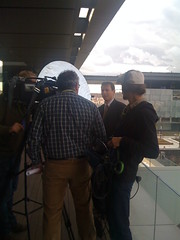
It was an interesting experience and a lot of activity for a few seconds of movie…

The questions that I answered included:

1. Telefonica is the leader of Telcos worldwide. How you would like to tighten this position?
2. Isn´t it very difficult to keep this position, cause Telefonica has activities in very different countries?
3. At the MWC will be present some very important technologies. For example NFC. Is it important for some future projects of Telefonica and when do you think there will be a breakthrough in the mass market?
4. Do you think the fixed network will have a future?
5. Which market is much more important, the South American or the European?
6. Is Telefonica developing some wireless standards after wimax or hsdpa?
7. Do you think there will be some bounds in the future for wireless technologies like LTE?
8. Where do you see Telefonica in 10 years?

See for yourself which of them have been selected for the reportage.
Enjoy!

Thursday, December 25, 2008

Merry Xmas and Happy New Year


Hoping the best for 2009. Wishing you the best for 2009.

Thursday, November 06, 2008

R&D in Spain

On Nov 6, I participated in a discussion on TV about the situation in Spain with respect to investment in R&D in comparison with the rest of the world. The program has been broadcasted on InterEconomia TV (click here to see it). Some quick numbers. Only three Spanish companies in the top100. Telefonica, with an investment of 600M euros in 2007, is number 40, and invest 4 times as much as the second Spanish company (Indra). Telefonica is responsible for almost 45% of the total Spanish investment in R&D, and if one looks at the IBEX 35 companies, Telefonica is responsible for 85%. By far Telefonica is the largest Spanish company investing in R&D, and as such serves as a national R&D motor, helping many small companies and universities in accessing R&D funds .

Interested in why this is the case? Have a look at the program (20 min). Enjoy!

Sunday, October 26, 2008

Hybrid Worlds

Since the financial crisis started, I have the feeling that "Hybrid Worlds" have become a reality. In "hybrid worlds" the virtual and physical worlds come together; the internet and the real world, virtual reality, etc. In this financial crisis, it seems that financial instituations (physical world) and their stock value (virtual world) have come very integrated. The connection is as follows: a bank possesses many assets, many of them are on the stock exchange. Those assets go down in the crisis, and so thus the value of the bank. In order to accomodate for this (virtual)loss, the bank needs to make provisions. If the losses are too big, the bank needs government help, or it goes bankrupt. Nothing more physical then a bank going bankrupt. But physically, the bank is exactly the same as before. It is the virtual world that has taken over ...

Wednesday, August 27, 2008

The Ambidextrous Organization

To achieve successful R&D and real innovation (bringing new things successfully to markets) is easy on paper but very hard in practice. Thousands of enterprises are struggling with this using a variety of methods, methodologies, instruments and organizations. Typical problems include how to ensure proper technology transfer, how (de)centralized should R&D and innovation be, how to initiate and foster new business, what is the right balance between short (improving existing business), medium and long term (create new business), etc, etc.

Recently I was recommended to read a 2004 article of the Harvard Business Review called “The Ambidextrous Organization”. It says, among others, that one of the main challenges companies face is to -at the same time- exploit existing business and explore new business. Companies need to be able to look backward and forward at the same time, while those two activities have very different requirements (e.g. in strategic intent, critical tasks, competencies, structure, compensation, culture, etc). Not surprisingly, companies struggle to deal with those conflicting requirements. In this article, the authors have investigated 35 attempts to launch breakthrough innovations in different industries. Their study shows that organizations use one of four possible ways to manage those innovations within their organizational structure. By far, the ambidextrous organization is the most (and only) successful one. An ambidextrous organization isolates the operation of the new business from the existing business by giving it freedom to organize and structure itself as appropriate, while it uses top-level executive involvement to keep the new business connected to the organization. Top-level involvement ensures visibility of the new business to the decision organs and evidences importance of the initiative to the organizations. 

This makes a lot of sense and seems relatively straightforward to apply. But how easy is it to put in practice in real organizations ….?

 Enjoy!

Wednesday, May 07, 2008

Google's Innovation Machine

The April edition of The Harvard Business Review features an article about how Google performs and manages its innovation: Reverse Engineering Google’s Innovation Machine. The article explains Google’s innovation ecosystem, which includes Content Providers, Consumers, Advertisers and Innovators. The ecosystem helps Google to know and involve its customers, to serve as a platform for third parties for delivering their services, and to provide value for advertisers. All information passes through Google’s infrastructure providing it with a wealth of relevant information on user preferences, actual use of services, etc.

It describes Google’s 1200 quarter forecast (300y), which provides the company with a long term vision and mission: “to organize the world’s information and make it universally accessible and useful”. Part of this vision is currently being monetized through advertisement.

It also details to some extent the famous 20% that Google employees have to spend on innovation (other things than their daily business).

An interesting case study, especially for telcos, which are currently reflecting on whether they should continue to be only a “dump pipe”, or, in addition, a “smart pipe”, or even a “service provider”.

Enjoy!

Monday, April 14, 2008

Business in Bottom of Pyramid Countries?

Recently I read a paper of Prahalad and Hammond that was already published in the Harvard Business Review as early as 2002. Now in 2008, it still seems very interesting, actual and worthwhile pursuing. The title of the article “Serving the World’s Poor, Profitably.” The paper tells that large multinational companies can do good for the poorest people in the world. A free version of the paper can be downloaded from the World Resources Institute (http://pdf.wri.org/whatworks_serving_profitably.pdf). In this post I will briefly write the things that most attracted my attention.

Being poor is expensive. In the Indian city of Mumbai, prices of the same articles are consistently higher in poor areas than in upper-class areas. Articles include credits, water, phone calls, diarrhea medication and rice and prices range from 1.2x to 53x more expensive. The main reason is the lack of efficient distribution channels.

The world pyramid. 100M people have an average annual salary of more than 20.000$. 2 billion people earn between 2.000-20.000$, and 4 billion people earn less than 2.000$. Usually, multinational corporations serve the 100M rich people, assuming that the bottom of the period (BOP) cannot afford their services. The paper shows that this is not necessarily true (on the contrary) and that many poor people do want to spend some money on services and/or products. E.g., in the same town of Mumbai, 85% of the household own a TV set, while not having a proper house. The telco Grameen provides many BOP people with mobile access by having villagers in rural areas share one mobile line. Whereas each person maybe spends very little money on communication, a large village may spend as much as 1000$ per month.
The paper argues that one should not underestimate the improvements that for example communications infrastructure can provide to the poorest people. Globalization is often (rightly) associated with outsourcing part of the value chain to cheap (and thus poor) countries. But Prahalad and Hammond show that it can also be different.

The business interest is manifold. First, there is a huge opportunity for growth in terms of customers. Second, usually conditions of operating in BOP countries are very harsh, forcing companies to provide innovative solutions. Once those solutions work in the difficult environments, moving those solutions to more friendly markets may result more efficiency and in significant savings. Many large companies, therefore, setup an R&D centre in BOP countries focused on local opportunities. There exists a telecommunications operator that is only operating in poor countries that has an EBITDA as high as 65%

My conclusion is that while many of us rule out the possibility to do business in BOP countries because 1) we think there is no business, 2) conditions are very difficult (humanitarian, political, nature), 3) we want (or need) to be a social responsible corporation, and 4) the kind of managerial skills needed are totally different, it actually makes a lot of sense to consider BOP markets seriously.

The authors’ answer to the question “is it worth the effort?” “Big corporations should solve big problems.”

Friday, January 04, 2008

Patents in Spain

The other day I had a meeting with the Spanish Office for Patents and Trademarks. They gave me some high-level indicators of the situation of patents in Spain. The figures are taken from the notes I took during the conversation, so they may not be accurate. Nevertheless, they are interesting and show the (poor) state of play in Spain.


  • 3000 Patents per year in Spain
    —CSIC: 130 patents/y
    —All univs: 300 patents/y
    —Grupo Antolin: 20/y
    —Most patents are in pharma sector
    —350 patents/year in ICT area
  • EPO denies 20% of patents
    —What is accepted usually is modified since original filing
  • ICT patents typically last around 7 to 8 years
  • 5% of patents reach market
  • Two types of patents
    —High quality (with exam)
    —Low quality (no exam)
  • Filing patent in Spain costs 480€, legal support up to 3000€
  • 12-18 months between filing patent in Spain and decision of world-wide coverage (involves costs)

Judge for yourself, but I think we have some work to do here ...

Tuesday, December 25, 2007

Merry Xmas and Happy New Year


Merry Xmas and Happy New Year to all of you. May 2008 bring tolerance, health, happiness to all of you, and peace to the world.

Saturday, November 17, 2007

Trip to South Korea

From 19-23 November, 2007 I will visit South Korea in search for the latest developments in ICT. We will visit several small and large companies. I will post some multimedia information on my TV channel@kyte (clicking on the channel activates the control to move backward and forward through the content).

Saturday, November 03, 2007

Beyond the (current) web

End of October, I gave a lecture at the University CarlosIII in Madrid -in the context of a Master in Web Engineering- about what I consider to be beyond the current web. In a nutshell, it means more intelligence, everywhere (operationalized in this lecture by Semantic Technologies and Ambient Intelligence). If you understand Spanish you can see the lecture (60 min) here.

Saturday, October 27, 2007

Everybody can be a journalist and publisher (in realtime)

I started testing out kyte, a web/mobile application that let's you post multimedia content (pictures, text, movies, sound, etc.) in realtime. Content can be uploaded from a browser (drag and drop), and from mobile phones and PDAs; it is straightforward. In a sense, it gives anyone his/her personal TV channel. Mine is here (only test material so far).

And below I embed the channel (http://www.kyte.tv/rbenjamins) directly.


If you don't see anything, it isn't that easy, afterall...

Sunday, September 30, 2007

Use and Abuse of Internet

The Science and Technology Committee of the House of Lords has published an extensive report on Personal Security on the Internet in the context of crime and organized abuse (pdf here). Their conclusion is that e-crime is increasing in a rapid way, but there is still time for governments to take appropriate action:

"The threat to the Internet is clear, but it is still manageable. Now is the time to act, both domestically, and internationally, through the European Union and through international organisations and partnerships."

Whatever measures (no measure is also a measure) are proposed, they will always provoke reactions that go in all directions: from "this will kill the spirit of Internet" to "this still will leave many security holes", and all positions in-between those extremes. Ideal policies do not exist; all of them have advantages and disadvantages. It is the weighing of those (dis)advantages that makes the policy. A useful question to ask oneself in such situations is: “What is worse?” which in this case translates to:

What is worse? Making Internet so secure that no abuse is possible, but that at the same time kills the proper nature of Internet? Or, keeping Internet open, thereby taking for granted that some abuse will occur?

How much abuse are we willing to tolerate? To what extent do we accept to limit new possibilities and opportunities offered by this new instrument, for the sake of security?

Those are the real questions, but there is nothing new to those questions. Politicians deal with them on a daily basis (not saying that they take the right decisions …)


Sunday, September 02, 2007

Monitoring for Technological Strategy


To be competitive in a fast changing, global environment requires monitoring many different things (competitors, technology, social trends, economies, countries, etc) in different places (physical, virtual). In this post, I am concerned with technology. How does one know what technology to monitor? There are many considerations, aspects, view points, trade-offs to take into account. The sketched figure shows the main ideas (to be improved).

Many large organizations have a strategic focus for a particular time frame. This focus provides an overall context for what technologies to monitor. It is important to notice that monitoring a technology involves much more than the technology alone. Monitoring a technology because it seems a nice technology does not help. Important notions to consider while monitoring include the business context, potential applications, market readiness, economics, society aspects, legal issues, etc. In this sense, the word “technology” is too limited to express what we need to cover. It would be more appropriate to refer to technological trends in a market, society and business context.

Apart from the strategic focus, additional factors that determine what technology trends to monitor include what your competitors are doing and what technological trends are emerging.

All those inputs help us in deciding what technologies (or “concepts”) to monitor. The result can be seen as a “technology/concept map”. This map tells us where we should put our effort in our monitoring activity. Notice that the map itself is a living thing, which needs regular updates, and in particular upon changes of the strategic focus, new emerging technologies, social changes that make existing technologies suddenly relevant, competitor activities, etc.

Once we know what to monitor, we still need to find out the best way to monitor each technology, i.e. what antennas to use and where. The following dimensions for characterizing technologies may be of help in this respect:

- Market readiness
- Technological maturity
- Legal aspects related to the use of the technology
- Social acceptation
- Applicability for the different business lines (the more the better)
- Applicability horizon for the business
- Technologies potentially provided by providers (especially for those with a short horizon, e.g. less than one year)
- Skills available in-house
- Available partners
- Etc.

All those factors help us in deciding when we should know about the technologies/concepts. Before it becomes business, before it appears in popular press, or before appearing in specialized press, before it enters the blogosphere, before it enters the research world, or before it enters garage startups, or even before it happens … It is common sense that the earlier one wants to be informed, the more expensive and difficult it is. It is simple to discover that a company offers a new service by reading it in the technology supplement of a newspaper. Low cost, low risk, but also low strategic value. On the other hand, to discover that a small startup constructs key technology for building a competitive edge in your business (and before the whole world knows it) is difficult and expensive. High cost, high risk, but high potential strategic value.

Corresponding to the different time frames desired for monitoring things, different methods apply from using Internet (reading blogs, search engines, intelligent agents, etc, to having your people in situ close to where things tend to happen. Those are two extremes in between which there are many different options, each with its advantages and disadvantages. This trade-off requires explicit decisions.

Once decisions are made, we have all parameters defined for setting up our Technology Observatory relevant for our strategic focus. The result of the observatory is a set of actions and/or recommendations for each technology concerned, such as passive monitoring, setting up a consortium, pursuing standards, partner with other organizations, buy a company, delete, etc. This can be expressed in another map, let’s say the technology/concept recommendation map. Moreover, sometimes it is possible to find external funding and partners to monitor a certain technology or relevant aspect of it.

The technology observatory may provide relevant information for different target audiences. The obvious one is the top management of the organization, but other targets include middle management, the whole company, partners and even the outside world. Each audience may require its own format, in order to ensure that the information arrives, and is actively consumed by the right people at the right time. The whole enterprise of technology monitoring is a waste of effort and money if this last step is not taken care of.

There are two relevant feedback loops to be aware of, and to stimulate. Monitoring the technology trends may change the technology/concept map by additions, deletions or modifications. Another and more profound feedback is to modify the strategic focus of the organization based on the technology observation performed. It may be the case that some observation suddenly opens a new business perspective to such extent that the strategic focus needs to be changed accordingly.

Thursday, August 02, 2007

Technological Strategy 2.0

There are many ways to make a strategical technology plan for a company. One can analyze lots of relevant information, do a synthesis and come up with a plan. One of the key points is to decide what information to analyze, and what aspects to include.

If web3.0 already existed in its full extent, I could just type in some phrase such as "Find me relevant aspects for defining a Technological Strategy in the Telecommunitacions sector taking into account concepts like ICT, Internet, Multimedia, Ambient Intelligence, Intelligent neworks", and I would get relevant information to consider. Unfortunately, web3.0 is not yet there in this extent.

But maybe web2.0 can help out? Maybe there is a community out there that can suggest interesting things to take into account for defining such a plan.

Open innovation? Innovation 2.0? Name it what you want. I invite everybody to react with relevant concepts, notions, technologies, trends, business ideas, etc, etc. to contribute to such a technological plan in an innovative way ...

Thank you in advance!

Change of focus

Due to my professional change, I have adapted the topic of the blog to the more general topic of technological innovation.